

Coinbase Has Become the Fidelity of Crypto—and What It Means for the Great Wealth
Coinbase is becoming the Fidelity of crypto. Learn how centralized exchanges shape the great wealth transfer—and why estate planning must adapt for digital assets.

By Maya Powers
Estate Planning Content Expert, Trust & Will
The story of crypto has always carried a libertarian edge. The mantra “not your keys, not your coins” warned investors to never trust centralized platforms. True ownership meant hardware wallets, seed phrases, and total control.
But reality looks different.
Convenience vs. Control
Recent data shows that 64% of crypto owners keep their assets on centralized exchanges. Coinbase leads by a wide margin, with Robinhood and Crypto.com following, and a long tail of smaller platforms making up the rest. Meanwhile, about 36% of users still use private wallets (often hardware devices like Ledger or Trezor), especially for larger or long-term holdings.
This paints a picture of a hybrid strategy:
Everyday balances, active trading, and quick mobile access live on Coinbase or Robinhood.
Long-term holdings migrate to offline storage.
It’s not unlike how investors split money between checking accounts and retirement funds—liquid vs. locked up, short-term vs. long-term.
Why Coinbase Stands Out
The platform dominance of Coinbase is striking. It’s not just the biggest—it has become the default gateway for mainstream crypto investors. In many ways, Coinbase now plays the same role in digital assets that Fidelity or Schwab play in traditional finance: a recognizable, regulated, and relatively trusted household name.
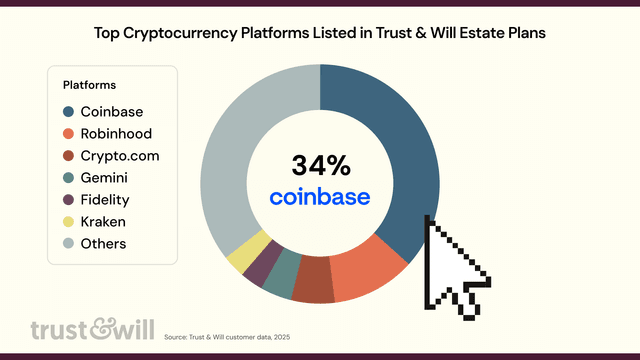
This consolidation matters. While crypto once promised radical decentralization, the concentration of assets in a handful of centralized exchanges signals that consumers crave stability over ideology.
Crypto’s Great Wealth Transfer: Not Keys, But Logins
What happens when the largest wealth transfer in history intersects with crypto?
For years, the fear was: what if heirs lose the hardware wallet? What if they misplace the seed phrase?
The bigger risk today is simpler: what if they don’t have the login?
If nearly two-thirds of crypto assets sit on platforms like Coinbase, then inheritance won’t hinge on recovering private keys—it will hinge on accessing account credentials, navigating KYC requirements, and working with platforms to validate estate claims.
Why Estate Planning Must Adapt
Estate planners, technologists, and regulators face a new challenge. The future of inheritance isn’t just about bank accounts and property titles. It’s also about:
Coordinating with major crypto platforms to streamline inheritance processes.
Building estate plans that account for digital credentials as much as physical documents.
Ensuring heirs understand both the assets and the tools needed to access them.
The hybrid model complicates things further. Some assets will be sitting in Coinbase accounts; others may still live on hardware wallets. Families will need clarity on where assets are stored and how they can be accessed.
What Comes Next
The Great Wealth Transfer won’t just reshape real estate and retirement portfolios—it will also redefine digital inheritance. The data makes one thing clear: most families won’t be wrestling with obscure crypto wallets. They’ll be dealing with a handful of major platforms, with Coinbase at the center.
That creates both a challenge and an opportunity. With the right infrastructure, partnerships, and planning, digital wealth transfer can be made as seamless as passing down a house deed or a brokerage account. Without it, families risk losing not just passwords—but generational wealth.
Final Thought
Crypto started as a rebellion against centralized finance. Ironically, the way it will be inherited looks a lot more like traditional finance than anyone expected. Coinbase has become the Fidelity of crypto—and estate planning must evolve just as quickly as wealth itself.
Trust & Will makes estate planning simple so you can create a customized, state-specific plan from the comfort of your own home. Take our free quiz to discover which estate plan best fits your needs today, to secure your family’s future.
Is there a question here we didn’t answer? Browse more topics in our learn center, visit our Frequently Asked Questions (FAQ) page, or chat with our member support!
Trust & Will is an online service providing legal forms and information. We are not a law firm and we do not provide legal advice.
Last updated: March 20, 2026


Related Articles
View All Articles
Estate Planning - 24 min read min read
The 2026 Death & Inheritance Report: When, Where, and Why American Families Talk About Death, Inheritance, and Estate Planning

Financial Advisors - 4 min read
How Advisors Help Families Name Their Quarterback Before a Crisis Does

Estate Planning - 12 min read