
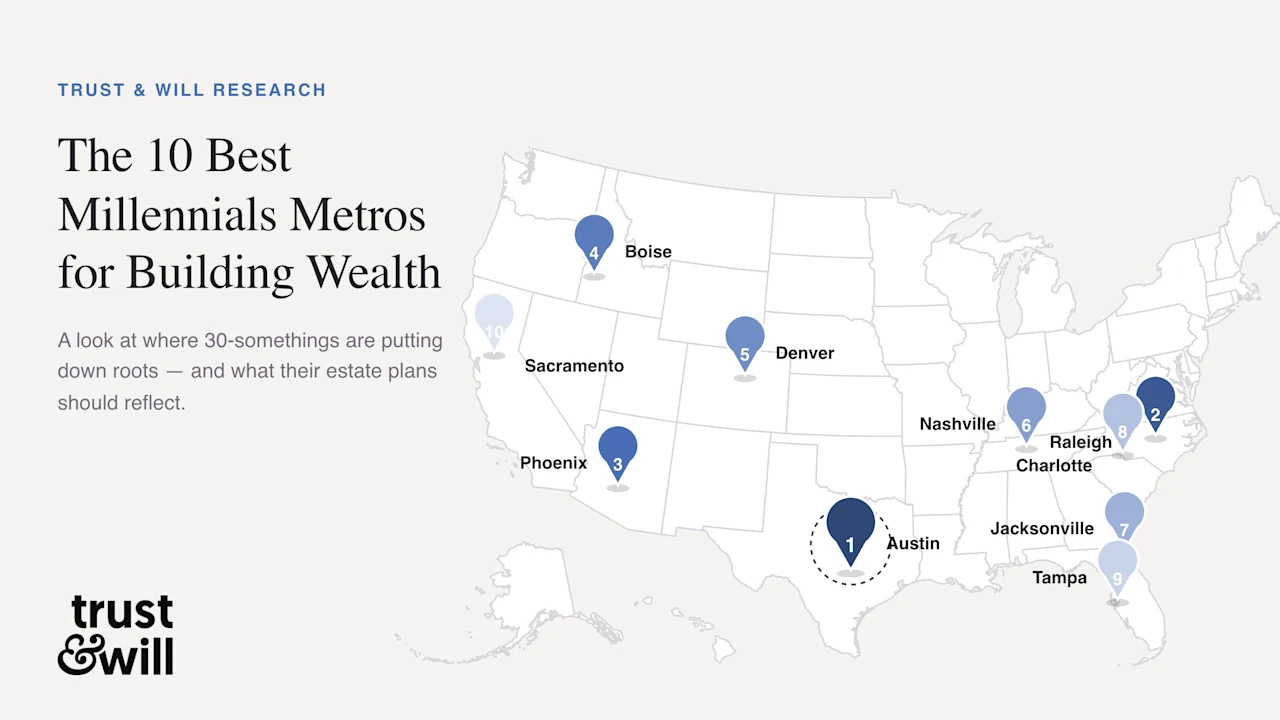
Millennial Money Map: 10 U.S. Metros Leading in Jobs, Income and Housing
A new report from Trust & Will ranks 73 U.S. metros on jobs, income, assets, and housing to spotlight the top markets where affluent millennials are building wealth.

Content & Comms, Trust & Will
Millennials are entering a financial environment unlike ever before. Estimates differ, but they all point to somewhere around $124 trillion that will be transferred to younger generations within the next 20 years. In terms of shaping careers, buying homes, investing and local economic development – that amount of money will significantly impact millennials’ lives as they are set to receive the largest share of the Great Wealth Transfer.
We analyzed eight indicators across the 73 most populated millennial U.S. metros to identify where affluent millennials currently reside and where conditions point to future growth. The Index is made up of local GDP growth, growth in employment for people aged 25-44, median household income growth, recent start-up activity, the number of high-income filers and high-value asset holders and two housing indicators: the Zillow Home Value Index and a five-year trend of building permit applications.
The ten best-performing metros tend to be in the South and West. This is not indicative of a migration pattern; it shows where the eight indicators currently align.
The large-scale wealth transfer to come will put millions of larger, more complex assets in the hands of younger individuals. Preparing for that is important. By having clear beneficiary designations, an updated will or trust, and a simple plan for what to do with money in the immediate future, you can avoid making mistakes when money starts moving.
All ranks below are out of 73 metros. Lower rank is stronger, and 1 is best.
1) Austin–Round Rock–San Marcos, TX
Overall Rank: 1
Millennial Population Density: 25.84%
Economic Indicators Rank: 5
5‑yr GDP Growth: 63.50% (#1)
Employment Change: 19.38% (#2)
Median HH Income Change: 23.45% (#33)
Startup Density: 16,876 (#21)
Wealth Concentration Rank: 8
High‑Income Tax Filers: 9.39% (#7)
High Value Asset Indicator: 12.80% (#15)
Housing & Real Estate Rank: 10
Zillow Home Value Index: $451,858 (#25)
Real Estate Permits Change: 22.54% (#17)
Best positions are GDP growth #1 and prime‑age employment #2, both top 3% of the study. High‑income filers #7 is in the top 10%. A softer spot is median income growth #33, about the 45th percentile. Permits #17 are the top 23%. Net‑net, Austin combines fast output, opportunity for prime‑age talent and strong wealth signals, with a construction pipeline that helps absorption.
2) Raleigh–Cary, NC
Overall Rank: 2
Millennial Population Density: 21.59%
Economic Indicators Rank: 8
5‑yr GDP Growth: 46.45% (#10)
Employment Change: 11.55% (#16)
Median HH Income Change: 25.17% (#21)
Startup Density: 8,188 (#36)
Wealth Concentration Rank: 11
High‑Income Tax Filers: 8.46% (#8)
High Value Asset Indicator: 3.46% (#41)
Housing & Real Estate Rank: 11
Zillow Home Value Index: $450,409 (#26)
Real Estate Permits Change: 22.64% (#16)
High‑income filers #8 sits in the top 11%, while GDP growth #10 is top 14% and permits #16 top 22%. The lag is high‑value assets #41, lower half of the study. Raleigh’s appeal is a balanced economic base with steady wealth signals and an active building pipeline.
3) Phoenix–Mesa–Chandler, AZ
Overall Rank: 3
Millennial Population Density: 21.39%
Economic Indicators Rank: 6
5‑yr GDP Growth: 51.54% (#4)
Employment Change: 9.65% (#24)
Median HH Income Change: 24.93% (#22)
Startup Density: 26,894 (#11)
Wealth Concentration Rank: 26
High‑Income Tax Filers: 5.61% (#30)
High Value Asset Indicator: 13.82% (#14)
Housing & Real Estate Rank: 7
Zillow Home Value Index: $456,834 (#24)
Real Estate Permits Change: 31.29% (#6)
Permits #6 and GDP growth #4 both land in the top 8% of metros, and startup density #11 is top 15%. Weaker points are employment growth #24 and high‑income filers #30, both around mid‑pack. Phoenix mixes a strong build pipeline and entrepreneurship with solid but not dominant wealth density.
4) Boise, ID
Overall Rank: 4
Millennial Population Density: 20.97%
Economic Indicators Rank: 4
5‑yr GDP Growth: 56.26% (#2)
Employment Change: 15.77% (#4)
Median HH Income Change: 26.23% (#14)
Startup Density: 6,400 (#44)
Wealth Concentration Rank: 32
High‑Income Tax Filers: 5.66% (#29)
High Value Asset Indicator: 2.11% (#54)
Housing & Real Estate Rank: 13
Zillow Home Value Index: $493,999 (#19)
Real Estate Permits Change: 9.85% (#31)
Economic momentum is the headline. GDP #2 and employment #4 are both top 6%. Startup density #44 and high‑value assets #54 are in the lower half. Boise shows how fast growth and stable housing values can offset thinner legacy wealth.
5) Denver–Aurora–Centennial, CO
Overall Rank: 5
Millennial Population Density: 25.36%
Economic Indicators Rank: 14
5‑yr GDP Growth: 44.77% (#13)
Employment Change: 9.19% (#27)
Median HH Income Change: 23.59% (#30)
Startup Density: 20,425 (#17)
Wealth Concentration Rank: 9
High‑Income Tax Filers: 8.23% (#10)
High Value Asset Indicator: 10.49% (#20)
Housing & Real Estate Rank: 15
Zillow Home Value Index: $592,884 (#11)
Real Estate Permits Change: -5.23% (#48)
Wealth depth is the standout. Wealth rank #9 is top 12%, and high‑income filers #10 is the top 14%. ZHVI $592,884 is the highest price point among the top 10, while permits #48 sit in the bottom third. Strong networks and higher prices define the trade‑offs.
6) Nashville–Davidson–Murfreesboro–Franklin, TN
Overall Rank: 6
Millennial Population Density: 22.70%
Economic Indicators Rank: 9
5‑yr GDP Growth: 49.52% (#8)
Employment Change: 14.64% (#6)
Median HH Income Change: 23.36% (#34)
Startup Density: 10,451 (#30)
Wealth Concentration Rank: 25
High‑Income Tax Filers: 6.23% (#26)
High Value Asset Indicator: 7.69% (#24)
Housing & Real Estate Rank: 9
Zillow Home Value Index: $459,668 (#23)
Real Estate Permits Change: 18.67% (#19)
Employment #6 is top 8% and GDP #8 top 11%. Income growth #34 and startup density #30 are mid‑pack. Nashville’s path is steady jobs, reasonable pricing and solid permitting that help renters become owners.
7) Jacksonville, FL
Overall Rank: 7
Millennial Population Density: 20.75%
Economic Indicators Rank: 3
5‑yr GDP Growth: 52.24% (#3)
Employment Change: 14.12% (#8)
Median HH Income Change: 26.32% (#13)
Startup Density: 10,658 (#29)
Wealth Concentration Rank: 38
High‑Income Tax Filers: 5.34% (#39)
High Value Asset Indicator: 4.29% (#37)
Housing & Real Estate Rank: 33
Zillow Home Value Index: $357,233 (#44)
Real Estate Permits Change: 23.99% (#14)
The economy does the heavy lifting. GDP #3 and employment #8 are in the top 11% or better. Wealth density ranks in the lower half, but ZHVI $357,233 is the lowest price point in the top 10 and permits #14 are the top 19%. That mix can be attractive for first‑time buyers who want growth plus entry points.
8) Charlotte–Concord–Gastonia, NC–SC
Overall Rank: 8
Millennial Population Density: 21.18%
Economic Indicators Rank: 10
5‑yr GDP Growth: 45.43% (#11)
Employment Change: 12.43% (#13)
Median HH Income Change: 23.58% (#31)
Startup Density: 15,942 (#22)
Wealth Concentration Rank: 24
High‑Income Tax Filers: 6.52% (#23)
High Value Asset Indicator: 6.60% (#27)
Housing & Real Estate Rank: 29
Zillow Home Value Index: $390,896 (#32)
Real Estate Permits Change: 10.91% (#29)
Strengths are GDP #11 and employment #13, both top 18%. Housing indicators are middle of the pack with ZHVI #32 and permits #29. Charlotte’s appeal is consistency without extreme trade‑offs.
9) Tampa–St. Petersburg–Clearwater, FL
Overall Rank: 9
Millennial Population Density: 20.01%
Economic Indicators Rank: 2
5‑yr GDP Growth: 50.90% (#5)
Employment Change: 13.58% (#10)
Median HH Income Change: 26.87% (#11)
Startup Density: 21,608 (#16)
Wealth Concentration Rank: 43
High‑Income Tax Filers: 4.85% (#48)
High Value Asset Indicator: 9.42% (#21)
Housing & Real Estate Rank: 25
Zillow Home Value Index: $368,374 (#40)
Real Estate Permits Change: 31.25% (#7)
Economic rank #2 is top 3% and permits #7 top 10%. High‑income filers #48 is bottom third, while ZHVI sits in the lower half. The takeaway is a strong growth engine, active building and relatively approachable prices.
10) Sacramento–Roseville–Folsom, CA
Overall Rank: 10
Millennial Population Density: 20.58%
Economic Indicators Rank: 20
5‑yr GDP Growth: 35.56% (#34)
Employment Change: 9.92% (#21)
Median HH Income Change: 36.52% (#1)
Startup Density: 12,377 (#25)
Wealth Concentration Rank: 23
High‑Income Tax Filers: 6.73% (#21)
High Value Asset Indicator: 4.57% (#32)
Housing & Real Estate Rank: 1
Zillow Home Value Index: $590,697 (#13)
Real Estate Permits Change: 34.07% (#3)
Housing rank #1 and median income growth #1 are both best in the study, with permits #3 in the top 4%. GDP growth #34 is mid‑pack. The profile is strong income gains and an active building pipeline at a higher price point.
If you live in one of these metros, the building blocks of wealth are already in place: a growing local economy, strong hiring for ages 25 to 44, rising pay, a deeper pool of high earners, and housing indicators that make clear both today’s prices and how much new supply is coming. Use the ranks to benchmark your city and to frame decisions about career moves, saving, investing and home buying.
A practical way to turn this map into action:
Careers: strong GDP and employment ranks signal thicker job ladders. Consider role changes or upskilling while those markets are expanding.
Housing: pair ZHVI with permits. Higher ZHVI with low permits suggests tight inventory and more competition. Rising permits suggest new options coming to market.
Entrepreneurship: higher startup density often aligns with hiring pathways and local networks. If equity participation matters, prioritize metros where startup density ranks well.
Why This Matters For Financial Advisors
This study shows the locations of affluence and upward mobility amongst millennials, and where growth in local economies, income, and housing markets create fertile ground for wealth creation and accumulation. At the same time, our survey data highlights a clear gap between millennials’ financial potential and their estate-planning readiness. A Trust & Will survey found that 62% of millennials do not have a will or trust. More than half (56%) say they do not know what would happen to their assets if they died without an estate plan.
That disconnect — between wealth opportunity as reflected in metro-level conditions, and personal planning readiness — creates a powerful window for advisors to add value. When the metro indicators show strong economic momentum, rising incomes or real-estate activity, millennials in those markets are likely entering life stages that benefit from strategic planning: home buying, liquidity, growth investing, and eventual wealth transfer. Advisors who reach out early, before the financial inflection point, can position estate planning not as a compliance chore, but as a foundational pillar of a holistic wealth strategy.
Recent data from another Trust & Will report reinforces this: among advisors who integrated digital estate-planning services into their offerings, 59% saw increases in client satisfaction and 56% reported higher client retention. More than half (55%) noted an uptick in client acquisitions, and 42% said estate planning contributed to net asset growth among new clients.
For advisory firms that want to target millennials in the top metros, this suggests a dual strategy:
Lead with readiness. In metros with strong wealth concentration and income growth (e.g., Austin, Denver, Sacramento) begin conversations around wills, trusts, beneficiary reviews, titling, and liquidity preparation. These are likely clients with both the assets and the mindset for legacy planning.
Lead with growth. In metros with high economic momentum or real-estate activity (e.g., Phoenix, Tampa, Jacksonville) position estate planning as part of a broader wealth-accumulation strategy: cash-flow management, future home buying, investment allocation, and eventual multi-generational wealth structuring.
Digital estate-planning tools make it easier to onboard millennials without forcing them to choose between legacy protection and convenience. That alignment increases the odds that planning becomes part of a long-term client relationship, not a one-off transaction. As the landscape shifts, advisors who embrace estate planning early could capture both the growing wealth and the loyalty of the next generation.
Methodology
How the ranking works
The report evaluates 73 U.S. metropolitan statistical areas using public datasets and a clear weighting scheme to track economic, wealth and real estate change.
Economic Indicators (60% of the score): five‑year GDP growth from FRED (2018 to 2023), employment change for ages 25 to 44 from ACS S2301 (2018 to 2023), median household income change from ACS S1901 (2018 to 2023) and startup density from the Annual Business Survey (2022).
Wealth Concentration (30%): the proportion of high‑income tax filers and high‑value asset indicators from IRS Statistics of Income (2020).
Housing and Real Estate (10%): the Zillow Home Value Index for May 2025 and the five‑year change in building permits from the Census Building Permits Survey (2018 to 2023).
Context only: Millennial Population Density / Rank from ACS S0101 (2018–2022 5‑year) is descriptive and not scored.
1. Index construction
1.1 Categories, metrics, weights and sources
1.2 Metric‑specific processing
Five‑Year GDP Growth: percent growth, 2018–2023.
Median Household Income Change: percent change, 2018–2023.
Employment ages 25–44: percent change in employed persons, 2018–2023.
Startup Density: total new and young employer firms in 2022.
High‑income filers and high‑value assets: IRS SOI, 2020.
ZHVI: May 2025 for anchor cities.
Building permits: percent change, 2018–2023.
1.3 Standardization and ranking
Rank each metric for all MSAs. Rank 1 is best.
Multiply each metric rank by its weight and sum to a preliminary composite. Lower is better.
Normalize composites to a 0–100 scale.
Sort on the normalized scores to assign final ranks. The same process yields category‑level ranks.
2. Data treatment and methodological notes
Proxy usage
GDP Growth: complete metro coverage; no proxies.
IRS SOI: when exact metro designations are unavailable, use the most comparable MSA. Anchor city remains consistent.
ACS S1901, ACS S2301, ABS, Building Permits: if records are missing, use the most comparable MSA with the anchor city held constant.
ZHVI: collected for anchor cities only.
Imputation
Startup Density: two MSAs lacked data (Colorado Springs, CO; McAllen‑Edinburg‑Mission, TX). We imputed the mean of the bottom 25 metros.
3. Inclusion criteria
MSAs with complete data across the majority of indicators were included. No principal cities were excluded unless significant data gaps made inclusion unfeasible.
4. Data sources
U.S. Census Bureau. ACS S0101 Age and Sex, 2018–2022 5‑year.
U.S. Census Bureau. ACS S1901, 2018–2023.
U.S. Census Bureau. ACS S2301, 2018–2023.
U.S. Census Bureau. Annual Business Survey, 2022.
Internal Revenue Service. Statistics of Income, 2020.
Federal Reserve Economic Data. Metro GDP, 2018–2023.
U.S. Census Bureau. Building Permits Survey, 2018–2023.
Zillow Research. Zillow Home Value Index, May 2025.
Trust & Will makes estate planning simple so you can create a customized, state-specific plan from the comfort of your own home. Take our free quiz to discover which estate plan best fits your needs today, to secure your family’s future.
Is there a question here we didn’t answer? Browse more topics in our learn center, visit our Frequently Asked Questions (FAQ) page, or chat with our member support!
Trust & Will is an online service providing legal forms and information. We are not a law firm and we do not provide legal advice.
Last updated: March 24, 2026


Related Articles
View All Articles
News - 5 min read
Trust & Will Launches a Chartered Retail Trust Company, Becoming the First Digital Estate Planning Platform to Serve as a Regulated Corporate Fiduciary

News - 4 min read
Trust & Will's 2026 Death & Inheritance Report: 1 in 4 Americans Have Never Talked to Their Family About Inheritance

Estate Planning - 12 min read