
Responsible AI in Estate Planning: What Every Family Should Know Before Using AI
Learn what responsible AI looks like in estate planning—how purpose-built tools educate, organize, and escalate to professionals instead of replacing judgment.

By Molly Peters
Head of Product Marketing, Trust & Will
TL;DR: The question isn't whether AI belongs in estate planning. It already does. The real question is what responsible AI looks like. Generic chatbots can explain concepts, but they aren't connected to your actual documents, your family information, or your assets, and nothing stops them from answering anyway AI worth trusting with something so personal does three jobs well: it educates, it organizes, and helps you decide when to bring in a human professional. This article explains how to tell the difference and why that difference will define the next decade of estate planning.
Artificial intelligence has gone from novelty to necessity in barely a year. According to Pew Research Center, 44% of U.S. adults now report using ChatGPT—more than double the share in 2023.People now use it to draft emails, summarize contracts, and answer questions that once required hours of research. So it was only a matter of time before someone typed a different kind of question into a chat window: "Can AI help me create an estate plan?"
Recent coverage from legal and financial publications has answered with a warning: don't trust a generic chatbot with your will. That warning is fair. Estate planning involves state-specific legal requirements, sensitive financial details, and family dynamics no public chatbot can infer from a prompt. Someone who owns a business plans differently than someone with only a 401(k). Parents of young children face different decisions than retirees. What's right for one family can be actively wrong for another.
But the headlines are failing to ask the more useful question: what role AI should play, and what role it should never play. Families already expect technology to simplify complex decisions. Advisors want better ways to prepare for client meetings. Attorneys want tools that cut administrative work without touching professional judgment. AI can serve all three goals, but only if it's built responsibly.
Why "Can AI Do This?" Is the Wrong Question
Estate planning has long been one of the few areas AI technology couldn't easily touch. Creating a plan means balancing legal requirements against deeply personal decisions about family, health, and legacy, nothing like booking a flight or ordering groceries.
Large language models changed that overnight. As soon as they could produce fluent, confident answers, people started asking them things like: Do I need a will or a trust? Should I put my house in a trust? Who should be my executor? These sound like reasonable questions for an assistant. The problem is that estate planning rarely has a universal answer. Generic AI models excel at recognizing patterns in language. Estate planning requires recognizing patterns in a person's life, and those are different skills.
Consider a question that sounds simple: "Should I create a living trust?" An honest answer depends on where you live, whether you own property in multiple states, whether your estate is taxable, whether you have a business, minor children, or a beneficiary with special needs, and whether you already have documents in place. Change one variable and the right answer changes. Without that context, any response is incomplete, no matter how persuasive it sounds.
That points to the real failure mode, and it isn't just hallucination. Confident, fluent language is easy to mistake for complete guidance, and in estate planning, completeness matters as much as accuracy. An answer that omits one consideration can leave someone believing they've solved a problem they've only partly addressed. Then there's the question of privacy that few people stop to ask before typing: financial accounts, property ownership, health details, family relationships. What actually happens to that information after you press enter? Responsible AI starts long before an answer is generated. It starts with how information is collected and protected in the first place.
The Estate Planning AI Maturity Model: A Framework for Evaluation
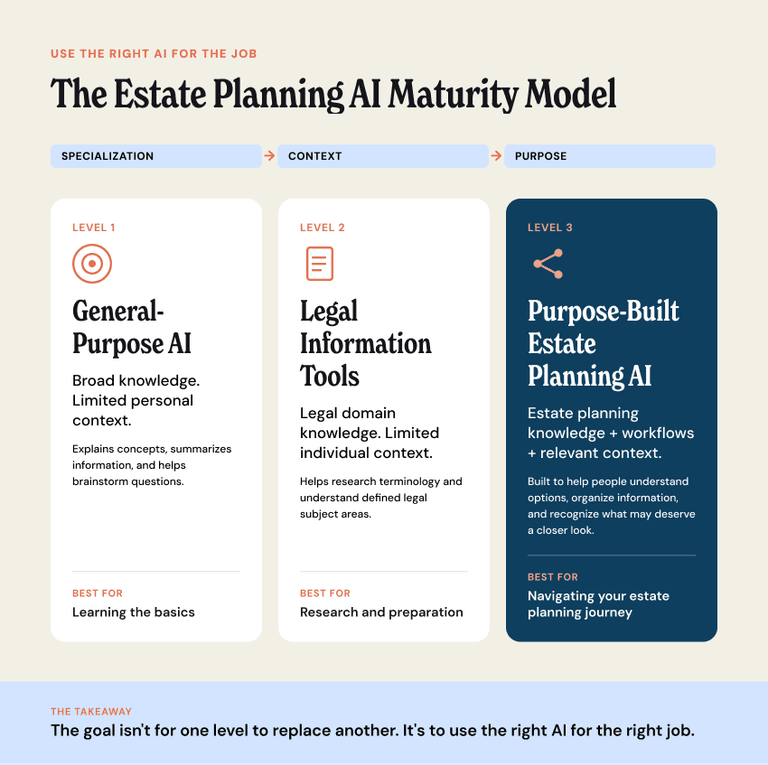
Treating "AI" as one technology is like treating "vehicles" as one category. A bicycle, a sedan, and a commercial jet all move people, but no one uses them interchangeably. AI is the same. Image generators, fraud detection tools, and large language models share underlying techniques but serve entirely different purposes. Estate planning AI deserves the same distinction, viewed less as "safe" versus "unsafe" and more as a spectrum of responsibility.
At the first level sits general-purpose AI, the kind most people already use daily. It's excellent at explaining concepts, summarizing information, and brainstorming ideas, but it doesn't have built-in access to your actual documents, accounts or family situation. It's a good place to learn the basics or come up with questions for a professional, and a poor place to get a personalized answer.
One step up are legal information tools, built to organize information within a defined legal subject area. They're more focused than a general chatbot, but they still lack access to your personal documents, your finances, or your family situation. They're useful for researching terminology and preparing for a conversation with someone qualified, but they still can't tell you what's right for you specifically.
The level that actually matters for families is purpose-built estate planning AI: systems designed around estate planning workflows, documents, and clear safety boundaries. This is AI that understands what a trust does, what a beneficiary designation is, and how to help people decide when a question goes beyond that. Even here, the goal isn't replacing individualized legal advice. It's helping people understand their options, organize their information, and decide what may deserve a second look.
No level replaces another. The common mistake is expecting general-purpose AI to do the work of purpose-built AI, or expecting any AI to replace the judgment of a licensed professional. The future isn't about collapsing these into one tool. It's about letting each one do what it's actually good at.
The Three Jobs of Responsible Estate Planning AI
The framework above describes what kind of AI you're dealing with. But once you know you're working with purpose-built technology, a simpler test applies to any single interaction: is it doing its job?
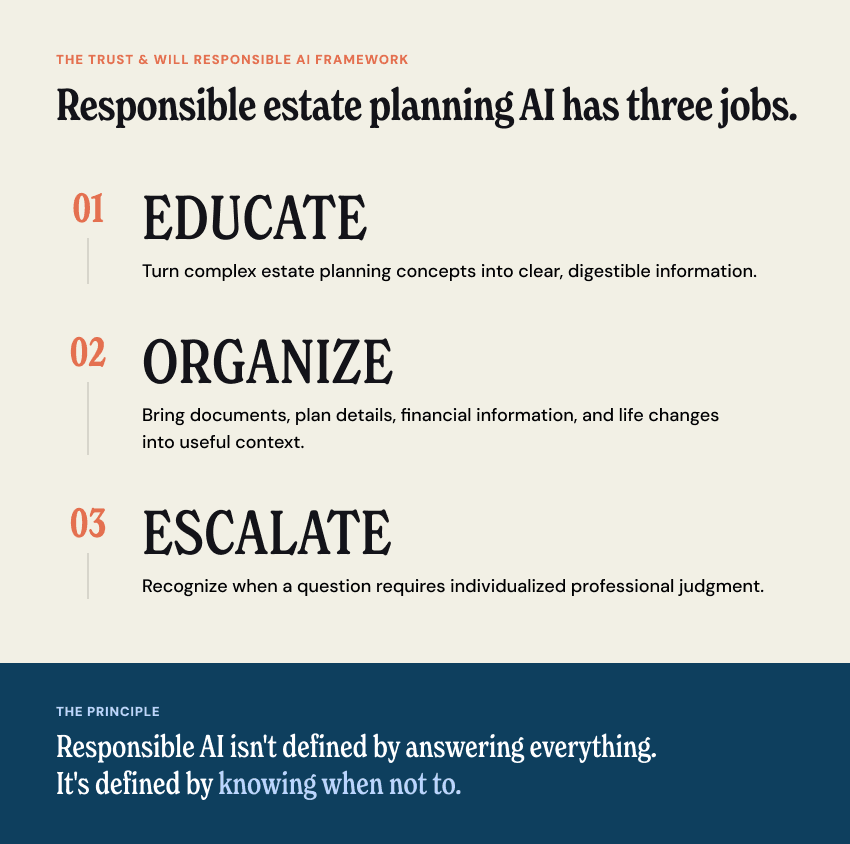
Responsible estate planning AI has exactly three jobs, and it should never confuse them.
Educate. It translates legal and financial concepts into plain language: what a successor trustee does, why beneficiary designations override a will, what probate actually involves.
Organize. It takes scattered information, whether that's an old PDF in a filing cabinet, a decade of life changes, or a folder of financial accounts, and turns it into something a person can actually understand and act on.
Escalate. Judgment calls based on someone's individual facts are for the person to make, not the AI; that's a fixed line, not something it weighs case by case. When someone asks it to make that kind of individual call for them, the responsible move isn't a confident guess. It's saying so plainly and pointing them to options to consult a licensed professional who can advise about their full situation.
The most dangerous AI failures in this space aren't the ones that look wrong; they're the ones that look right. A system that only explains and organizes, but never escalates, will eventually produce a fluent, well-organized, wrong answer to a question it isn't supposed to answer at all. Restraint, not capability, is the metric that matters most here. The most trustworthy systems are the ones willing to say "I don't have enough information to answer that responsibly," not the ones that always have something to say. That means treating privacy as a design principle rather than an afterthought, and spending as much effort explaining what the system can't do as what it can. A tool that plainly states "I can't give individualized legal advice" is demonstrating maturity, not weakness.
Responsible AI in Practice
These principles are easy to state and harder to build. The real test is whether they show up as engineering decisions rather than marketing language. Our platform shows the Three Jobs framework applied concretely.
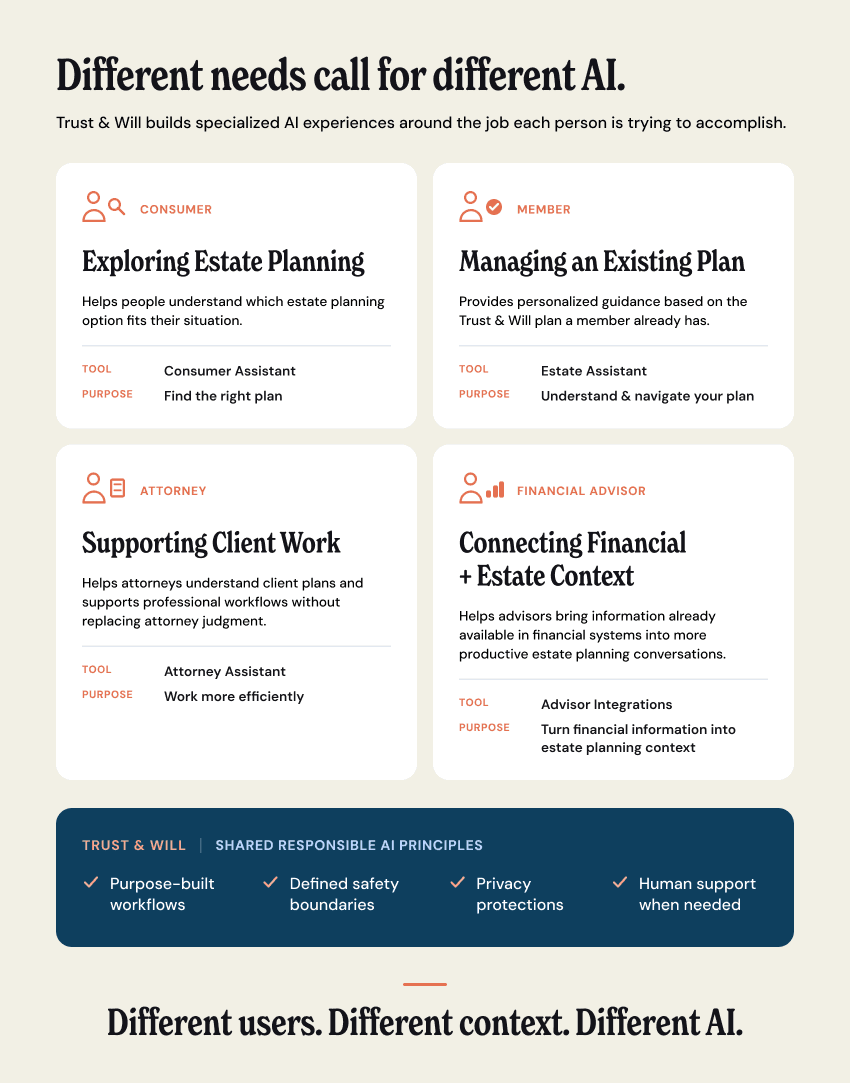
Instead of one generic chatbot expected to answer every question for every audience, we built multiple specialized AI agents. Someone exploring estate planning for the first time has different needs than an attorney reviewing client documents or an advisor prepping for an annual review. Those aren't variations on the same job, they're different jobs. Our consumer-facing assistant helps people learn about the different types of plans so they can decide which type of plan fits their situation. Our Estate Assistant is explicitly designed to avoid individualized legal advice: not because it's missing facts about your plan, but because that judgment call belongs to you, or to a licensed professional, never to AI. That boundary is a feature, not a limitation.. Our Attorney Assistant supports professional workflows without touching the attorney's own judgment calls.
The same philosophy extends to privacy: personally identifiable information, such as Social Security numbers and bank account details, is stripped or anonymized before a request ever reaches a public AI service. Privacy is engineered into the workflow rather than left to depend on what a member remembers not to type. In our own in-app surveys, 94% of Estate Assistant users reported a positive experience, a signal that boundaries and usefulness aren't actually in tension.
Advisor integrations round out the picture, translating financial information already on file into estate planning context so a client conversation doesn't start from zero. Across every version of the tool, the job of the AI stays consistent: not replacing expertise, but making it more accessible.
How to Evaluate Any Estate Planning AI Platform
As more platforms add an "AI" label, telling them apart won't require a computer science degree, just better questions.
Does it know its limits? A trustworthy system distinguishes clearly between education and personalized legal advice. If every answer sounds absolute, that's a warning sign, not a feature.
Was it built for estate planning, or bolted onto a generic model? Ask whether the workflows, safeguards, and domain knowledge were purpose-built, or whether it's a general chatbot answering legal questions because it can.
How is sensitive information protected? How is it stored, who has access, is it anonymized, and is it used to improve the model afterward? That's consistent with the National Institute of Standards and Technology's AI Risk Management Framework, which lists privacy, transparency, explainability, and accountability among the characteristics of trustworthy AI systems. Those principles become especially important when AI is used to help people make legal and financial decisions.
Does it make professionals more effective, or try to replace them? The strongest products position attorneys and advisors as essential partners, reducing administrative drag rather than automating judgment.
Does it help you understand a plan, not just create one? Families revisit plans after marriages, births, divorces, deaths, relocations, and business changes. The best systems treat estate planning as a lifelong relationship, not a one-time document.
The Future Belongs to Responsible AI
The question isn't whether AI becomes part of estate planning. It already has. The real question is whether the AI being built deserves the trust families are asked to place in it.
The organizations that lead the next generation of estate planning won't be the ones with the most sophisticated models. They'll be the ones that pair genuine innovation with clear boundaries, strong privacy protections, and real respect for professional expertise. That's what responsible AI looks like, and it's what families deserve.
Frequently Asked Questions
Can ChatGPT write a will?
It can produce language that resembles one, but that doesn't make it a valid substitute for a properly executed estate planning document. A legally effective plan depends on your circumstances, your state's requirements, and correct execution. AI can educate, but it shouldn't be your only source of individualized legal guidance.
Can AI replace an estate planning attorney?
No. AI can't replace the legal judgment of an attorney, but an attorney isn't necessary for every estate plan. Purpose-built platforms like Trust & Will can help you create and manage your estate plan on your own, with responsible AI making the process easier to understand and navigate. If you want personalized legal guidance or an extra set of eyes, Trust & Will can also connect you with an attorney for additional support.
Is it safe to upload estate planning documents to an AI platform?
It depends entirely on the platform. Before uploading anything sensitive, understand how the information is stored, protected, and processed. Responsible platforms are transparent about this by default, not only on request.
Can AI help me review an estate plan I created years ago?
Yes, and it's one of AI's most promising near-term applications: helping people understand documents they already have, and spot what might be outdated and decide when a life event may warrant a revision to an existing plan and when a professional review is warranted.
What makes purpose-built estate planning AI different from a general chatbot?
It's built around a specific domain, defined workflows, and clear safety boundaries, designed to help users understand concepts and navigate their own plans, and built to provide education so that a person can determine when a question needs a licensed professional.
Educational Disclaimer: This article is provided for educational purposes only and should not be considered legal, tax, or financial advice. Estate planning decisions depend on your individual circumstances and the laws of your state. If you have questions about your specific situation, consult a qualified estate planning attorney or other appropriate professional. Trust & Will is not a law firm, and nothing in this article or on our platform creates an attorney-client relationship.
Last updated: August 11, 2026


Related Articles
View All Articles
Estate Planning - 24 min read min read
The 2026 Death & Inheritance Report: When, Where, and Why American Families Talk About Death, Inheritance, and Estate Planning

Financial Advisors - 4 min read
How Advisors Help Families Name Their Quarterback Before a Crisis Does

Estate Planning - 12 min read