

Finishing Your Estate Plan: How to Sign, Witness, and Notarize Your Documents
Your estate plan is ready. Now make it legal. Learn exactly how to sign, find witnesses, get notarized, and store your documents the right way.

By Maya Powers
Estate Planning Content Expert, Trust & Will
You've completed the hardest part. Your estate plan documents are ready for review. Now comes the final step: making them legally binding. We're going to walk you through all of it.
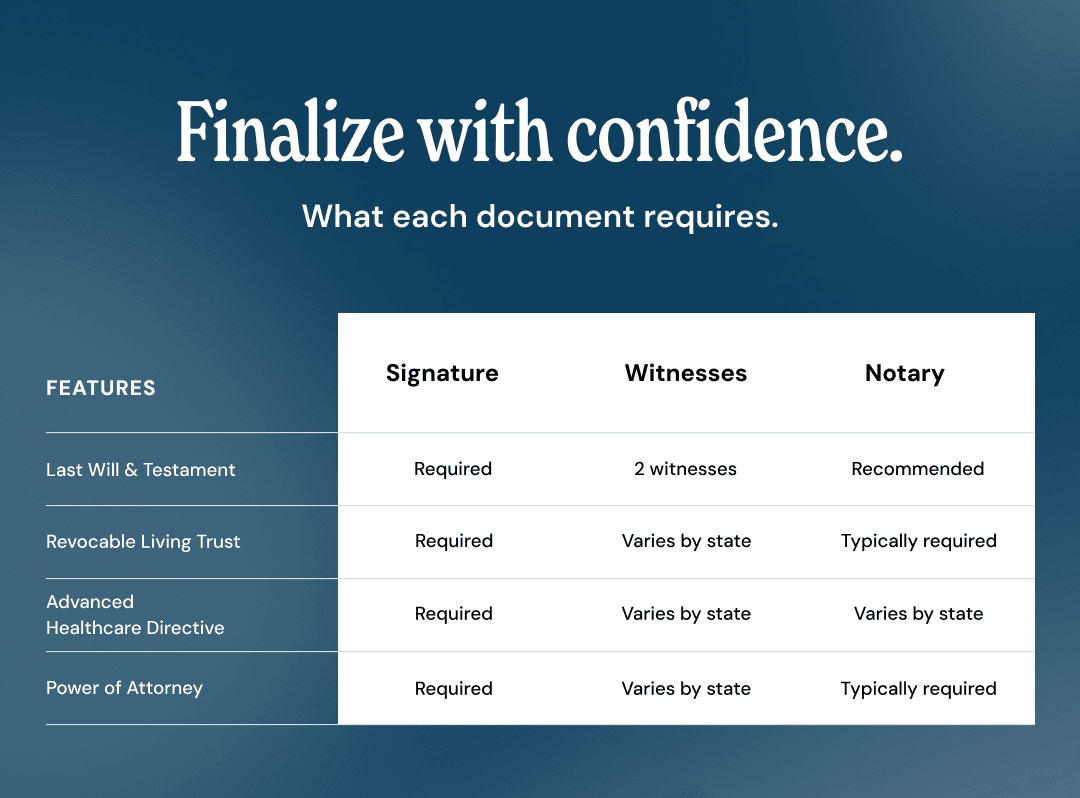
Not every document in your estate plan needs the same level of formality. Here's what to expect.Your Trust & Will documents include state-specific signing instructions. Always check those first.
Finding Witnesses
You typically need two adult witnesses who are not named as beneficiaries in your plan. They don't read your documents. They just watch you sign and then sign themselves. Any adult age 18 or older who isn't a beneficiary can serve as a witness.
So where do you find them? Your bank or credit union is a great starting point. Tellers often help and many branches have notaries on staff. You can also try a UPS Store or FedEx Office. A mobile notary service is another option. They come to you and often bring a second witness, typically for $25 to $75. And don't overlook the obvious: coworkers or neighbors are often happy to help.
Getting Notarized
A notary verifies your identity and confirms you're signing voluntarily. It's a quick step but an important one.
Common options include your bank (often free for account holders), a UPS Store or FedEx Office ($5 to $15 per signature), mobile notary services, or AAA offices (free for members). Many states now allow remote online notarization over video call. Check your state-specific instructions to see if that's available where you live.
Signing Day Checklist
Before your appointment, make sure you have everything ready:
Printed estate plan documents, all pages, unsigned
Valid government-issued photo ID
Blue or black ink pen (blue makes it easier to tell originals from copies)
Your two witnesses, confirmed and available
Payment for notary fees if applicable
The Signing Process
The actual signing is straightforward. Here's what happens step by step.
1. Gather everyone. You, your witnesses, and the notary all need to be present at the same time.
2. Present your ID. The notary verifies your identity.
3. You sign where indicated on each document.
4. Witnesses sign where indicated.
5. The notary stamps each document with their official seal.
6. Make copies. Keep the originals safe and give copies to your executor, trustee, or a trusted family member.
That's it. The whole process usually takes less than an hour.
Storing Your Documents
Keep your signed originals somewhere safe, fireproof, and accessible. Good options include a fireproof safe at home, a safe deposit box, your attorney, or a secure document storage service.
The most important thing? Make sure your executor or trustee knows exactly where to find them. The best estate plan in the world doesn't help if no one can locate it when it matters.
Common Questions
What if I make a mistake while signing? Don't use white-out. You can reprint the page and sign again. Our support team can help if you run into any issues.
Can my spouse and I sign at the same time? Yes! Same appointment, same witnesses, same notary. Each person signs their own documents separately.
Do my witnesses read my documents? No. They only observe you signing.
What if I make changes later? You can update your plan anytime through your Trust & Will account. Updated documents will need to be printed, signed, and notarized again.
You're one signing appointment away from a complete, legally binding estate plan. Take this last step. Your family will be glad you did.
Trust & Will makes estate planning simple so you can create a customized, state-specific plan from the comfort of your own home. Take our free quiz to discover which estate plan best fits your needs today, to secure your family’s future.
Is there a question here we didn’t answer? Browse more topics in our Learn Center, visit our
Frequently Asked Questions (FAQ) page, or chat with our member support!
Trust & Will is an online service providing legal forms and information. We are not a law firm and we do not provide legal advice.
Last updated: April 6, 2026


Related Articles
View All Articles
Probate - 5 min read
How to Find a Deceased Person’s Safe Deposit Box
Estate Planning - 24 min read min read
The 2026 Death & Inheritance Report: When, Where, and Why American Families Talk About Death, Inheritance, and Estate Planning

Financial Advisors - 4 min read