
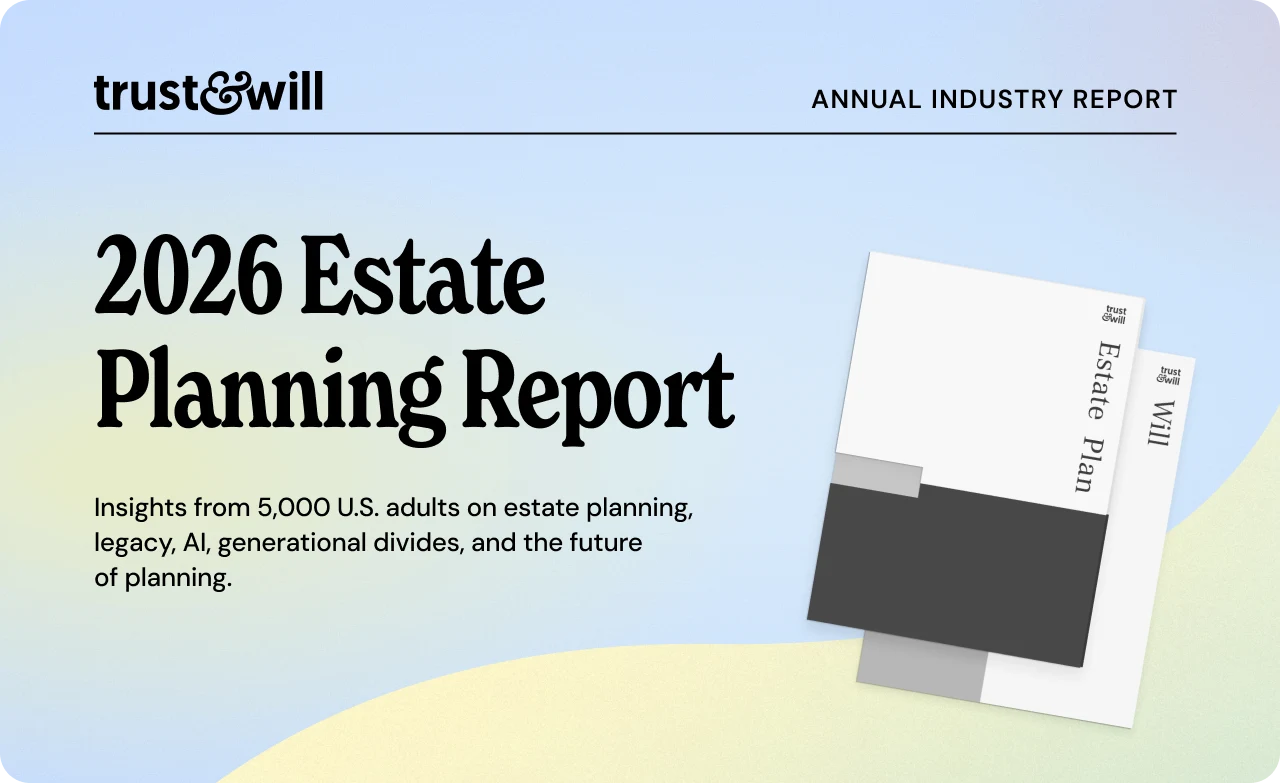
Trust & Will 2026 Estate Planning Report
New Trust & Will survey of 5,000 U.S. adults reveals estate planning gaps, shifting legacy expectations, generational divides, AI attitudes, and what it takes to get people to act.
Content & Comms, Trust & Will
Most Americans know they should have an estate plan. The majority have not made one.
That gap between knowing and acting is one of the most durable findings in estate planning research, and the Trust & Will 2026 Estate Planning Report confirms it is still wide open. But this year's data is not simply a repetition of what we have seen before. Beneath the headline numbers is a portrait of a country navigating genuine uncertainty: financial anxiety is elevated across every generation, the definition of legacy is expanding beyond money and property, and artificial intelligence has arrived as a real and increasingly relevant option in the estate planning conversation.
This report is based on a national survey of 5,000 U.S. adults conducted January 28 through February 5, 2026. What follows is a full analysis of the results, with meaningful splits by generation, gender, relationship status, homeownership, parent status, estate plan status, and region throughout. Where comparable data exists, we compare results to our 2025 Estate Planning Report to surface meaningful year-over-year trends.
Key Findings
56% of U.S. adults have no estate planning documents — no will, trust, Medical POA, Financial POA, or HIPAA authorization — essentially unchanged from 55% in 2025.
Will ownership dropped 5 points in a single year, from 31% in 2025 to 26% in 2026, while trust ownership rose 3 points, suggesting that people who are acting are choosing more comprehensive plans.
73% say estate planning is personally important (44% "very important," 29% "somewhat important"), yet the majority have not acted.
Gen X is the least protected generation: 62% have no estate planning documents, higher than Gen Z (54%), Millennials (58%), or Baby Boomers (48%).
45% of Americans are more financially concerned than they were a year ago, down slightly from 49% in 2025; but the share feeling less worried collapsed from 19% to just 8%.
42% of Americans would not know what to do if a family member died today, rising to 56% among those with no estate planning documents.
27% have never discussed end-of-life wishes with loved ones and do not plan to, with Gen Z (38%) and Millennials (32%) most likely to say they have no plans for this conversation.
Trust in AI for estate planning is accelerating: 30% of Americans now trust AI more than a human attorney for estate planning guidance, up 10 points from 20% in 2025. At the same time, AI skepticism dropped by the same margin, from 46% to 36%.
64% of Americans are either open to AI-assisted estate planning or have not yet formed a view: representing the largest and most reachable audience for modern planning tools.
41% of Americans say memories and relationships will be their most meaningful legacy, outranking financial assets, property, and values or lessons.
The Preparedness Gap — Who Has a Plan and Who Does Not
More than half of U.S. adults (56%) currently have none of the five core estate planning documents this survey tracked. No will. No trust. No medical directive. No Financial POA. No HIPAA authorization. That figure is essentially unchanged from 55% in 2025, and the flatness is itself the story: awareness is up, barriers are down, tools are more accessible than ever, yet the adoption gap has not moved.
That figure becomes more striking when set against the awareness data: 73% of respondents say estate planning is personally important to them. The gap between people who believe they need a plan and people who have one is the central story of estate planning in America in 2026.
Among those who do have documents, a will is the most common (26% of all respondents), followed by a Medical POA or advance directive (19%), a trust (14%), a Financial POA (11%), and a HIPAA authorization (10%). These documents frequently travel together: among will-holders, 41% also have a Medical POA and 28% also have a trust.
Comparing 2026 to 2025 reveals a shift in how Americans are planning, not just whether they are. Will ownership fell from 31% to 26% in a single year, a 5-point decline. At the same time, trust ownership rose from 11% to 14%, Medical POA ownership rose from 15% to 19%, and HIPAA authorization rose from 8% to 10%. The pattern suggests a meaningful compositional change: among those who are taking action, more are choosing comprehensive planning vehicles over a standalone will. The floor of unprotected Americans, however, remains stubbornly unchanged.
Gender
Men are more likely than women to have a will (31% vs. 22%), a trust (19% vs. 11%), and a Financial POA (14% vs. 10%). Women are more likely to have no documents at all (60% vs. 50%). This gap is consistent across every document type, and it likely reflects a mix of factors: who initiates financial conversations at home, differences in financial confidence, and how estate planning services have historically been designed and marketed.
Homeownership
Homeownership is one of the strongest predictors of planning behavior in this dataset. Among homeowners, 40% have a will, which is more than double the 16% rate among renters. Trust ownership follows a similar pattern (21% for owners vs. 10% for renters). Among those living with family or in other arrangements, only 8% have a will and 79% have no documents at all.
This correlation likely reflects the role of property in prompting people to think about what happens to what they have built. But it also reveals a serious access gap. Renters and people in non-owned housing still have dependents, medical wishes, financial preferences, and relationships worth protecting; and they are the most underserved group in the market.
RELATED: Will Preparation - Checklist for Making a Will
Relationship Status
Married respondents have the highest document ownership rates by a significant margin: 37% have a will, 21% have a trust, and 25% have a Medical POA. Among single or casually dating respondents, will ownership drops to 16%.
The most striking finding in this split involves people in serious relationships or engagements. Despite having a committed partner and all the financial and medical complexity that comes with a shared life, 68% of those in serious or engaged relationships report having no estate planning documents at all, which is a higher unprotected rate than divorced or widowed individuals (55%).
Without a formal healthcare proxy or power of attorney, an unmarried partner has no legal authority to make medical decisions on your behalf in an emergency. Without a will, they may have no inheritance rights in most states regardless of how long you have been together or what you have shared.
RELATED: Estate Planning For Unmarried Couples
Parent Status
Parents are more likely than non-parents to hold every document type in the survey: 31% of parents have a will vs. 19% of those without children who do not plan to have them. The gap is largest for trusts (17% vs. 10%) and Medical POAs (22% vs. 16%). Still, 50% of parents report having no estate planning documents at all; including documents that would name a legal guardian for their minor children.
For single adults without children, estate planning remains equally important. Without documents in place, critical decisions about health, finances, and assets fall to state law or the courts, not to the people you would actually choose.
RELATED: Estate Planning For Single People
Region
Regional differences in ownership are meaningful but not dramatic. The West has the highest trust ownership at 21%, nearly double the 13% rate in the Midwest. The Northeast leads for will ownership (28%) and Financial POA ownership (13%). The Southwest has the lowest will ownership (22%) and the highest no-document rate (58%). These differences likely reflect varying state probate laws, access to estate planning professionals, and cultural norms around family financial conversations.
The Awareness vs. Action Gap — Why People Do Not Get Started
Of respondents without a will or trust, only 43% say they are likely to create one in the next 12 months. The most commonly cited barriers are largely practical, and compared to 2025, the two biggest ones are shrinking fast. "Don't know where to start" dropped 10 percentage points in a single year (27% in 2025 to 17% in 2026). Cost concerns dropped 9 points (24% to 15%). Procrastination fell 7 points (30% to 23%). The expansion of online and digital estate planning tools appears to be moving the needle on awareness and perceived affordability. Yet the adoption gap remains unchanged. The barriers that are falling fastest are the most solvable ones. The remaining barriers are more deeply rooted in identity and relevance.
The top reasons for not having a will or trust in 2026:
"I do not think I have enough assets to need one" — 27%
"I have not gotten around to it" — 23%
"I do not know where to start" — 17%
"It feels too expensive" — 15%
"It feels too complicated" — 12%
"It feels uncomfortable to think about" — 12%
"I don't think it's relevant for people like me" — 11%
"I don't want to have uncomfortable conversations with family/loved ones" — 8%
One counter-signal deserves attention: "Not relevant for people like me" ticked up 3 percentage points from 2025 (8%) to 2026 (11%). That is the one barrier heading in the wrong direction, and it is arguably the hardest to fix through better tools or lower prices alone. The next challenge for the estate planning industry is one of reach and relevance: helping people understand that estate planning is not a product for a certain kind of person, but a tool for anyone who has people they care about or wishes worth protecting. If you own anything, care for anyone, or have opinions about your own medical care, you need a plan.
If you own anything, care for anyone, or have opinions about your own medical care, you need a plan.
The "not enough assets" belief is the most common reason Americans give for not having a plan; and it is a misconception. A will names a guardian for your children. A Medical POA designates who can speak for you if you cannot speak for yourself. A Financial POA gives a trusted person legal authority to act on your accounts in an emergency. None of those protections require wealth to matter.
None of those protections require wealth to matter.
RELATED: What is the Average Cost of a Will and Trust?
Barriers by Generation
Gen Z is more likely than any other generation to say they do not know where to start (23%). Baby Boomers are most likely to believe they do not have enough assets (35%), which is a particularly striking finding for a generation that has often accumulated significant home equity, retirement savings, and family obligations. Gen Z and Millennials are more likely than older generations to cite cost (15-16%) and complexity (14-15%) as barriers.
Barriers by Gender
Men are more likely than women to say estate planning is "not relevant for people like me" (13% vs. 10%). Women are more likely to say they are simply "not sure" why they have not acted (14% vs. 10%), suggesting a different kind of friction; not dismissal, but uncertainty about where to begin or who to trust.
What Would Make Getting Started Feel Easier
Among those without a will or trust, the most commonly cited enablers of action are:
A simple checklist — 19%
A lower-cost option — 17%
The ability to complete it online in one sitting — 12%
A recommendation from someone they trust — 11%
The option to have an attorney review the final documents — 11%
Talking to a real person for help — 10%
A guided conversation starter for family — 8%
An AI-guided tool — 6%
Baby Boomers (26%) are significantly more likely than any other generation to want a simple checklist. Younger generations skew toward online convenience and speed. Men are more likely than women to want an AI-guided tool (8% vs. 5%) and an attorney review option (13% vs. 10%).
Intent to Plan by Generation
Financial Anxiety
Financial anxiety remains broadly elevated, but the year-over-year picture is more nuanced than the headline number suggests. The share saying they are more financially worried than a year ago fell slightly from 49% in 2025 to 45% in 2026; which might look like improvement. But the share saying they feel less worried collapsed from 19% to just 8%. Americans are not becoming more confident about their finances; the optimism that existed in 2025 has largely evaporated. The dominant mood is sustained worry with no clear relief in sight.
Historically, elevated financial anxiety correlates with increased interest in protective planning; but this report's flat adoption numbers suggest that correlation is not holding in 2026. Anxiety alone does not move people to act. It has to be paired with a clear, accessible path forward.
The Conversation Gap — Families Are Still Not Talking
Having estate planning documents is one layer of preparedness. Having a conversation with your loved ones about what should happen when you die or become incapacitated is another; and they do not always go together.
Only 31% of Americans have had this conversation in the past 12 months. Another 20% had it more than a year ago. But 27% have never had this conversation and do not plan to.
That last figure has a sharp generational gradient. Among Gen Z, 38% say they have never had this conversation and do not plan to. Among Millennials, 32%. Among Baby Boomers, 17%. This is not simply a function of age or life stage. It reflects a real difference in how younger generations currently relate to end-of-life planning; the topic feels distant, uncomfortable, or not yet necessary.
Among those who have not talked and do not plan to, the reasons are a mix of timing, discomfort, and inertia. The most common: 22% say they do not think it is necessary yet, 22% say they plan to have it eventually, and 21% say the topic is simply scary or uncomfortable. Among men specifically, 28% say they do not think it is necessary yet — nearly 10 points higher than the 19% rate among women.
What the Conversation Gap Actually Costs
The stakes are concrete. Among all respondents, 42% say they would not know what to do if a family member died today. That number climbs to 56% among those with no estate planning documents; and drops to just 19% among will-holders and 18% among trust-holders. Family conversations and formal documents reinforce each other. Neither fully substitutes for the other.
What Americans Think They Will Leave Behind
When asked what they think will be the most meaningful thing they leave behind when they die, 41% of Americans say memories and relationships. Another 23% say values, lessons, or principles. Financial assets (22%) and property (22%) follow.
The year-over-year shift on this question is striking. In 2025, the legacy question offered a narrower set of options; and tangible assets topped the list. The 2026 survey introduced "memories and relationships" as an option for the first time, and it immediately dominated at 41%. That is not simply a result of adding a new answer choice. It reflects a genuine expansion of how Americans are thinking about what they leave behind, and what estate planning is actually for.
Also notable: the share of Americans who say they do not think they will leave anything meaningful behind dropped from 17% in 2025 to 10% in 2026. That is a 7-point shift in a single year. An estate plan is how you make that legacy real.
An estate plan is how you make that legacy real.
This matters deeply for how estate planning is framed: not as a financial transaction, but as an act of love and intentionality toward the people and things that matter most.
Legacy by Generation
Baby Boomers place the most weight on memories and relationships (49%), home and property (31%), and sentimental items or family traditions (25%). Gen Z and Millennials are considerably more likely than older generations to cite their digital life as part of their most meaningful legacy (15% and 14%, respectively, vs. 7% for Boomers) and their creative work (16% for Gen Z vs. 7% for Boomers).
Gen Z also stands out for a distinct orientation toward community: 22% say positive impact on other people or their community will be their most meaningful legacy, nearly double the Boomer rate of 12%. These are not abstract values. They are signals about what a well-designed estate plan should protect and prioritize for each generation.
Legacy by Gender
Men are more likely than women to say financial assets (27% vs. 19%) and community impact (20% vs. 14%) will be their most meaningful legacy. Women are more likely to cite memories and relationships (44% vs. 38%) and sentimental items or family traditions (22% vs. 17%).
Legacy by Parent Status
Parents are significantly more likely than non-parents to say memories and relationships (46% vs. 32%), values and lessons (28% vs. 15%), and home or property (26% vs. 17%) will be their most meaningful legacy. Among non-parents without plans to have children, the response "I don't think I will leave anything meaningful" is notably higher at 15% vs. 7% among parents — a finding that deserves attention, because everyone has something worth protecting and people worth naming.
Who Americans Trust for Estate Planning Guidance
When asked who they trust most for estate planning guidance, no single source commands a majority. Estate planning attorneys lead at 21%, followed by other family members (19%) and a spouse or partner (19%). Financial advisors follow at 14%.
A meaningful finding: 10% say they do not trust anyone for estate planning guidance or are not sure where to turn. This is not resistance; it is a genuine absence of a trusted entry point, and it is consistent across all generations.
The trust gap has practical consequences beyond estate planning itself. Trust & Will's Real Estate Inheritance Report, which surveyed 1,000 Americans on property inheritance, found that 37% of Americans would take estate planning advice from a housing professional — rising to 57% among Gen Z. That finding points to something broader: people are often most open to estate planning conversations in the context of a life event they are already navigating. Home purchases, inheritances, and major financial transitions are natural windows — and the professionals already in the room for those moments have more influence than they may realize.
Trust by Relationship Status
Among married respondents, 27% name an estate planning attorney as their most trusted source and 35% name their spouse or partner. Among single or casually dating respondents, attorney trust drops to 16%, spouse or partner drops to 8%, and family member trust rises to 22% — alongside an 11% rate of saying they do not trust anyone.
Single adults are more likely to feel adrift when it comes to this topic. They are more likely to rely on peers and family members who may be no more informed than they are, and more likely to feel genuinely uncertain about where to start.
Trust by Homeownership
Homeowners are significantly more likely to trust estate planning attorneys (28% vs. 15% for renters) and financial advisors (17% vs. 11% for renters). Renters are more likely to trust family members (22% vs. 17% for owners) and more likely to say they do not trust anyone (11% vs. 7%). Access to credible professional guidance is not evenly distributed.
Trust by Estate Plan Status
Among those who already have a will, 33% name an estate planning attorney as their top guidance source — the highest of any document group. Among those with no documents, only 15% name an attorney as their top source. Professional engagement is both a cause and an effect of having a plan. Breaking into that cycle for the unprotected majority requires meeting people where they are rather than waiting for them to find their way in.
How People Want to Create a Will or Trust
When asked how they would prefer to create or update a will or trust if they were starting today, responses span a broad spectrum.
The data:
Work with an estate planning attorney one-on-one: 34%
Not sure: 28%
Use an online self-serve service: 19%
Use a hybrid approach (online plus attorney review): 13%
Use AI-assisted document creation with attorney review required: 11%
Use an employer benefit: 11%
Use AI-guided guidance, not document creation: 9%
More than one in four Americans do not yet know how they would prefer to approach estate planning. These are not committed attorney-only clients or committed AI skeptics. They are people who have not yet found an entry point that fits; and they represent the most reachable audience in the market.
More than one in four Americans do not yet know how they would prefer to approach estate planning.
Generational differences are pronounced. Among Gen Z respondents, 20% say they would use AI-assisted document creation with attorney review required, and 14% would prefer AI-guided guidance — the highest rates of any generation for both categories. Among Baby Boomers, the same two categories draw only 7% and 4%, respectively. Working one-on-one with an attorney remains the most preferred option overall (34%), and that preference climbs to 41% among Baby Boomers and 55% among the Silent Generation.
One clear thread across all generations: when people are open to AI, they want attorney oversight as part of the experience. Only 5% of all respondents would use AI to create estate planning documents without any attorney review.
AI and Estate Planning — A Generational Fault Line With a Clear Direction
No topic in this year's report better captures where estate planning is headed than the data on artificial intelligence — and no finding shifts more dramatically year over year.
In 2025, 20% of Americans said they trusted AI advice more than a human attorney for estate planning. In 2026, that figure is 30%. In a single year, AI trust in estate planning jumped 10 percentage points. At the same time, the share saying they trust AI less than a human attorney fell from 46% to 36% — a 10-point drop on the skepticism side.
The headline number — 36% saying they would not use AI for estate planning under any circumstances — still matters. But paired with the year-over-year trend, it reads differently. A year ago, nearly half of Americans were actively skeptical. Today, a third are. The direction is clear and the pace is fast.
At the same time, 64% of all Americans are either open to AI for estate planning or have not yet formed a definitive view. The 19% "not sure" population is especially notable. These are not people who have decided against AI. They are people who need more information and the right experience to form a view.
The generational split on AI trust has sharpened since 2025. In 2026, 46% of Gen Z say they trust AI more than a human attorney — a figure that puts AI clearly in the majority position for the generation that will be the primary estate planning market within a decade.
The Gender Divide on AI
Men are more open to AI than women across every use category. Men are more likely to say they would trust AI advice more than a human attorney (38% much or somewhat more vs. 24% of women), and less likely to say they would trust AI much less (19% vs. 27%). Women's greater skepticism may reflect a stronger preference for the relational quality of working with a human professional, a more cautious orientation toward high-stakes decisions, or both.
What the Concerns Actually Are
The concerns behind AI skepticism are specific and addressable. The top worries among all respondents:
General distrust of AI: 28%
Lack of human judgment for unique situations: 28%
Privacy and data security: 26%
Incorrect information or mistakes: 26%
Fraud or scams: 21%
Risk of creating legal problems later: 16%
The nature of the concerns themselves has shifted since 2025. A year ago, the dominant worries were philosophical: Will AI replace human connection? Will it operate without proper oversight? In 2026, the concerns are more concrete: Will it get the facts right? Can I trust it with sensitive data? Could it create legal problems later? Practical concerns — accuracy, security, attorney oversight — are exactly the kinds of conditions that technology and platforms can be built to meet.
One particularly meaningful data point: among those with no estate planning documents at all — the group most in need of accessible planning tools — 18% say they have no concerns about using AI for estate planning. That is the highest "no concerns" rate of any subgroup in the survey, compared to 6-7% among those who already have documents. The people who need a better entry point into estate planning are the most open to trying a new one.
Digital Estate Planning — The Fastest-Growing Blind Spot
A connected but under-appreciated finding: 48% of Americans have no instructions in place for what should happen to their digital accounts and files when they die. No written instructions, no account-level legacy controls, no informal notes.
This gap is most pronounced among Gen X (53%) and Baby Boomers (54%) — the same generations that have accumulated the most history in digital accounts, from decades of email and financial records to irreplaceable photo archives and social media presence.
Among those who have made some arrangements:
21% have formal written instructions documented in a will, trust, or separate document
12% have set account-level controls such as Facebook's Legacy Contact or Google's Inactive Account Manager
12% have only informal arrangements like telling someone verbally or sharing passwords
Gen Z stands out here: 23% have set account-level controls — nearly three times the Boomer rate of 4%. This is the most digitally proactive generation when it comes to this specific kind of planning.
Even among those with formal estate plans, the digital gap is significant. Among will-holders, 23% have no digital instructions. Among trust-holders, 11% have no digital instructions. A traditional estate plan does not automatically address digital accounts and assets — it requires deliberate, specific attention.
RELATED: How to Create Your Own Digital Estate Plan
Learn more about building a digital estate plan at trustandwill.com/learn/digital-estate-planning.
Among those who said their digital life would be among the most meaningful things they leave behind — 12% overall, rising to 15% among Gen Z and 14% among Millennials — the urgency is compounded. These individuals are explicitly counting their digital presence as part of their legacy, yet most have made no formal arrangements to protect or transfer it.
RELATED: What Is A Digital Legacy & Why You Should Be Planning Yours
Pets and Estate Plans
Estate planning for pets is no longer a niche consideration. In 2026, 68% of Americans believe pets should be included in an estate plan in some form:
37% say pets should be treated with the same level of importance as people
21% say pets should be included, but not at the same level as people
10% say pets deserve even more consideration than people in an estate plan
11% say pets should not be included
That 68% figure is consistent with the directional finding from 2025, when 62% said pets should be treated with the same importance as people. The 2026 survey offered a more granular response scale — but the core finding holds: for the majority of Americans, a plan that does not account for their pets is not a complete plan.
The generational pattern is particularly pronounced. Gen Z (15%) is three times as likely as Baby Boomers (5%) to say pets should be treated with more importance than people in an estate plan. Among Gen Z and Millennials combined, pet-forward planning is not a quirk — it is an expectation.
What Motivates People to Finally Get a Plan
Among those who do have a will or trust, the most common motivations for creating one were:
Peace of mind: 39%
Protecting loved ones: 32%
Death of someone close: 19%
Reducing family conflict: 18%
Starting a family: 16%
Avoiding probate: 16%
A health scare: 14%
Peace of mind tops the list — and the research bears out why. Trust & Will's Peace of Mind Report found that people with estate plans are nearly five times less likely to feel anxious every day than those without one, three times less likely to lose sleep from worry, and significantly more likely to feel optimistic about the year ahead. The act of planning does not just protect your family — it changes how you move through your own life.
These motivations shift meaningfully by generation. For Gen Z respondents who have created documents, top motivations include starting a family (22%), marriage or a long-term partner (17%), turning 18 and becoming legally responsible for their own decisions (16%), and an employer-offered benefit (14%). These are life-event triggers concentrated in younger cohorts — and they tell a clear story about when and where to meet people in this life stage.
Among Baby Boomers with documents, avoiding probate (25%) and protecting loved ones (40%) rank significantly higher than among younger planners. Peace of mind remains the top motivation across all generations. For parents specifically, starting a family was cited by 20% as a motivation — consistent with what most estate planning professionals already know: having a child is one of the most reliable prompts for finally taking action.
What This Means for Consumers and Families
The most honest takeaway from this data is that most Americans already know estate planning matters. The research does not need to convince people it is important — 73% already agree. What it surfaces is the practical and emotional distance between that belief and the decision to act.
If you have been putting off creating a will or trust, you are far from alone — but being in the majority does not reduce the real risk. The 42% of Americans who say they would not know what to do if a family member died today are not unprepared because they do not care. They are unprepared because no clear path was ever offered to them.
A few things worth taking directly from this data:
The "I do not have enough assets" belief is a common and costly misconception. Estate planning protects your people, not just your property. Among renters, the rate of having no documents is 66%. Among those living with family, it is 79%. These are not people without relationships, responsibilities, or wishes worth protecting.
If you are in a serious relationship but not married, this data makes the risk particularly visible. Without formal documentation, your partner has no legal authority to make decisions on your behalf in a medical emergency and no automatic inheritance rights in most states. A basic set of documents — a healthcare proxy, Financial POA, and will — changes that completely.
For those with existing documents, this data is also a reminder that estate plans require maintenance. Among those with wills or trusts, 14% have never updated their documents, and 13% review them only once per decade or less. One encouraging year-over-year trend: the share who have never reviewed their plan appears to have dropped from 16% in 2025 to 11% in 2026. That is meaningful progress. But roughly 21% of plan-holders still rarely or never review their documents — operating on plans that may no longer reflect their current family structure, assets, or wishes. A plan that is five years out of date after a marriage, a new child, or a home purchase is a plan that may not do what you think it does. Review every three to five years, and after any major life event.
For the 48% of Americans with no digital instructions in place: your online accounts, photo archives, financial credentials, and social media presence deserve the same thoughtful planning you would give any other part of your estate.
What This Means for Professionals
For estate planning attorneys, financial advisors, and other professionals working with clients on legacy and long-term planning, this data offers a detailed map of where clients are, where they are stuck, and what is changing.
Gen X is the most underserved generation in the market right now. With 62% of Gen X respondents having no estate planning documents — the highest of any generation — and the near-certainty that this cohort is managing peak financial complexity, the unmet need here is large and urgent. Advisors who develop Gen X-specific outreach and accessible entry points are addressing the single biggest preparedness gap in the market.
The conversation gap is a direct practice opportunity. Among will-holders, 51% have had an end-of-life conversation with their loved ones in the past 12 months — and 7% say they have no plans to have this conversation at all, even with documents in place. Advisors who help clients find the right language and schedule the actual conversation create sustained value beyond document preparation and deepen the client relationship.
Serious but unmarried clients carry disproportionate risk. The data showing 68% of people in serious or engaged relationships have no estate planning documents should be a priority signal for any advisor working with clients in that life stage. Naming this gap explicitly during client reviews is likely to generate both trust and action.
AI is becoming part of the professional conversation whether firms engage with it or not. Among Millennials and Gen Z respondents who are open to AI, the vast majority want attorney review as a condition. That is not a challenge to the profession — it is a clear statement that human expertise remains central. Professionals and platforms that pair AI-assisted capabilities with transparent human review are meeting this moment directly.
Financial anxiety is elevated and the optimism of 2025 has not returned. The share saying they are more financially worried fell slightly from 49% in 2025 to 45% in 2026 — but the share feeling less worried collapsed from 19% to just 8%. Moments of sustained financial anxiety are known catalysts for protective planning conversations. Advisors who bring estate planning into current financial review conversations, rather than treating it as a separate, occasional engagement, are likely to find receptive clients.
Digital estate planning is a practice gap most advisors have not closed. Even among will-holders, 23% have no digital instructions in place. Given that 12% of Americans say their digital life will be among the most meaningful things they leave behind — rising to 15% among Gen Z — this is a growing area of genuine client need that can be addressed with relatively straightforward additions to existing workflows. [trustandwill.com/learn/difference-between-trust-and-will]
A quiet demographic signal in the guardian data is worth noting: fewer parents in 2026 are defaulting to their own parents or siblings as guardians for their children (each down 3 points from 2025), while slightly more are naming trusted friends (up 1 point). Chosen family is edging into a space that has traditionally belonged to biological family — a shift that advisors working with diverse client populations will want to acknowledge and plan around.
Frequently Asked Questions: 2026 Estate Planning Report
Based on a national survey of 5,000 U.S. adults conducted January 28–February 5, 2026.
What percentage of Americans have no estate planning documents in 2026?
56% of U.S. adults have no estate planning documents — no will, trust, Medical POA, Financial POA, or HIPAA authorization — according to the Trust & Will 2026 Estate Planning Report. This is essentially unchanged from 55% in 2025.
What percentage of Americans have a will in 2026?
26% of U.S. adults have a will in 2026, down from 31% in 2025. Trust ownership rose over the same period from 11% to 14%, suggesting people who are acting are increasingly choosing more comprehensive plans.
Which generation is least likely to have an estate plan?
Gen X is the least protected generation: 62% have no estate planning documents, higher than Gen Z (54%), Millennials (58%), or Baby Boomers (48%).
Why don't most Americans have a will or estate plan?
The top reasons Americans give for not having a will or trust in 2026 are: believing they don't have enough assets (27%), procrastination (23%), not knowing where to start (17%), cost concerns (15%), and feeling it's too complicated or uncomfortable (12% each).
Do Americans trust AI for estate planning?
30% of Americans now trust AI advice more than a human attorney for estate planning, up 10 percentage points from 20% in 2025. Among Gen Z specifically, 46% say they trust AI more than a human attorney. When people are open to AI, they strongly prefer attorney oversight as part of the process.
What do Americans consider their most meaningful legacy?
41% of Americans say memories and relationships will be their most meaningful legacy, ranking above financial assets (22%), property (22%), and values or lessons (23%).
How many Americans would know what to do if a family member died today?
42% of Americans say they would not know what to do if a family member died today. That figure rises to 56% among those with no estate planning documents, and falls to just 18–19% among trust or will holders.
How many Americans have digital estate planning instructions?
48% of Americans have no instructions in place for what should happen to their digital accounts and files when they die. Even among will-holders, 23% have no digital instructions in place.
Do Americans include pets in their estate plans?
68% of Americans believe pets should be included in an estate plan in some form. 37% say pets should be treated with the same importance as people, 10% say pets deserve even more consideration, and 21% say they should be included but at a lower priority.
What motivates people to finally create an estate plan?
The top motivations among Americans who have created a will or trust are: peace of mind (39%), protecting loved ones (32%), the death of someone close (19%), reducing family conflict (18%), and starting a family (16%).
How was the Trust & Will 2026 Estate Planning Report conducted?
The Trust & Will 2026 Estate Planning Report is based on a random double-opt-in online survey of 5,000 U.S. adults, commissioned by Trust & Will and conducted by Talker Research between January 28 and February 5, 2026. The margin of error is approximately +/- 1.4 percentage points at the 95% confidence level.
Key Statistics: 2026 Estate Planning Report
Adults with no estate planning documents — 56% — flat vs. 55% in 2025
Will ownership — 26% — down 5 pts from 31% in 2025
Trust ownership — 14% — up 3 pts from 11% in 2025
Say estate planning is personally important — 73%
Would not know what to do if a family member died today — 42%
More financially concerned than a year ago — 45% — down 4 pts from 49% in 2025
Trust AI more than a human attorney for estate planning — 30% — up 10 pts from 20% in 2025
Gen Z trusts AI more than a human attorney — 46%
Say memories and relationships are their most meaningful legacy — 41%
No digital estate planning instructions in place — 48%
Believe pets should be included in an estate plan — 68% — up from 62% in 2025
Gen X with no estate planning documents — 62% — highest of any generation
Never discussed end-of-life wishes and don't plan to — 27%
Source: Trust & Will 2026 Estate Planning Report. Survey of 5,000 U.S. adults, January 28–February 5, 2026. Conducted by Talker Research.
METHODOLOGY
This random double-opt-in online survey of 5,000 U.S. adults was commissioned by Trust & Will and conducted by market research company Talker Research, in accordance with the Market Research Society's (MRS) code of conduct. The survey was fielded between January 28 and February 5, 2026.
The survey consisted of 30 questions and included three screener questions on parent status, relationship status, and housing status. Respondents were drawn from the general population of U.S. adults ages 18 and older. The sample includes representation across five U.S. regions (Northeast, Southeast, Southwest, Midwest, and West) and was analyzed across the following demographic and situational segments: gender (male, female), generation (Generation Z: born 1997-2008; Millennials: born 1981-1996; Generation X: born 1965-1980; Baby Boomers: born 1946-1964; Silent Generation: born 1927-1945), parent status, relationship status, homeownership status, and estate plan status (will, trust, Financial POA, Medical POA or advance directive, HIPAA authorization, and none).
The margin of error for the total sample of 5,000 is approximately +/- 1.4 percentage points at the 95% confidence level.
Cell size note: Cells are only reported on for analysis if they have a minimum of 80 respondents. The Silent Generation segment (approximately 1% of the total sample, or roughly 50 respondents) falls below this threshold and is excluded from primary demographic analysis throughout this report. Statistical significance is calculated at the 95% level.
Data quality: All responses were screened for speeding, duplicate submissions, and bot activity by Talker Research prior to delivery. Open-ended responses were reviewed for quality and coherence.
Limitations: This survey relies on self-reported data and reflects respondents' stated knowledge, attitudes, and behaviors, which may differ from actual documented planning status. The survey was conducted online and requires internet access, which may limit representation of certain populations. Responses reflect a point in time and may not account for changes in legal requirements, economic conditions, or individual circumstances that occurred after the fielding period.
Year-over-year comparisons: Results are compared where applicable to the Trust & Will 2025 Estate Planning Report, which surveyed 10,000 U.S. adults in January 2025, conducted by WeAreTalker (formerly OnePoll). The 2026 survey sample (n=5,000) differs in size and some question designs were updated or expanded between years. Where question design changed meaningfully — such as the addition of new legacy response categories — comparisons are noted with context and directional interpretation is favored over precise point-to-point comparison. Differences of fewer than 3 percentage points between years should be interpreted with caution given differing sample sizes and methodological variations.
This survey is directional and intended to provide consumer insights.
This survey was overseen by Talker Research, whose team members are members of the Market Research Society (MRS) and the European Society for Opinion and Marketing Research (ESOMAR).
This article is for informational purposes only and does not constitute legal, financial, or tax advice. Estate planning laws vary by state. Please consult a licensed estate planning attorney or qualified financial advisor for guidance specific to your situation.
Trust & Will is an online service providing legal forms and information. We are not a law firm and we do not provide legal advice.
Last updated: June 29, 2026


Related Articles
View All Articles
News - 5 min read
Trust & Will Launches a Chartered Retail Trust Company, Becoming the First Digital Estate Planning Platform to Serve as a Regulated Corporate Fiduciary
News - 4 min read
Trust & Will's 2026 Death & Inheritance Report: 1 in 4 Americans Have Never Talked to Their Family About Inheritance
Estate Planning - 12 min read